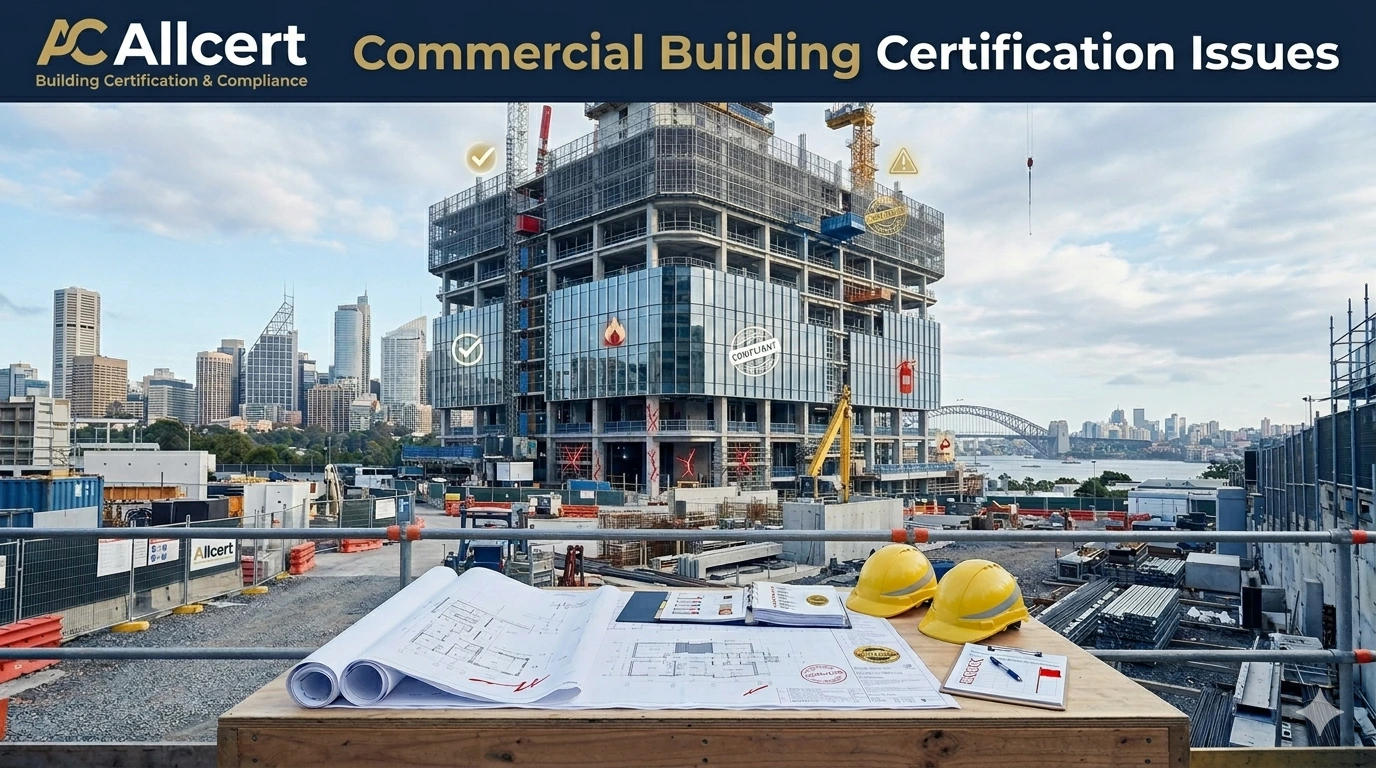
Construction in Australia is governed by many rules, standards and approval processes. Whether you are building a commercial property or making significant changes to an existing one dealing with certification can be one of the most challenging parts of the project. From documentation errors to compliance gaps certification issues can delay timelines increase costs and in the cases stop construction completely.
This guide breaks down the common commercial building certification issues explains the role of a private building certifier and helps you understand what steps to take.And how to apply for a construction certificate in NSW? To keep your project on track and compliant.
What Is Commercial Building Certification?
Building certification is the process of ensuring that a proposed or completed building complies with applicable building regulations, standards, and local planning controls as determined by a recognized authority. In New South Wales, the Environmental Planning and Assessment Act of 1979 (EP&A Act) and the Environmental Planning and Assessment Regulation govern this procedure.
It’s a big deal for properties. A certified building has to meet the fire safety requirements of the National Construction Code (NCC), accessibility requirements of the Disability Discrimination Act (DDA), and numerous other pieces of regulation. If the requirements are not met at any point, rectification work may commence, fines and enforcement action may be imposed by local councils, or by the NSW Building Commission.
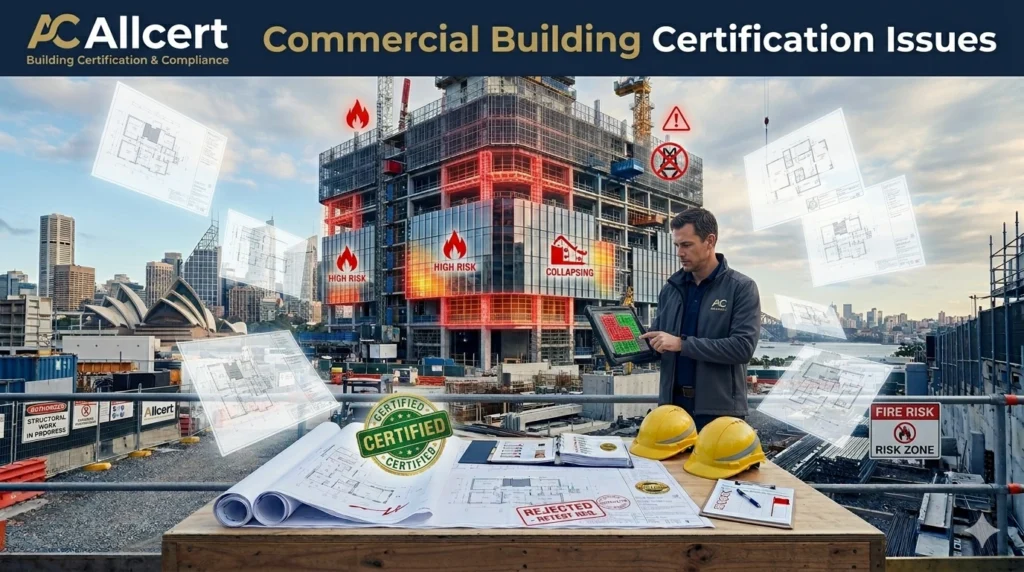
The NSW Building Commission estimates that building defects are estimated to cost the Australian economy billions of dollars every year, with commercial properties contributing a share of the costs of rectification. One of the best ways to avoid these expensive consequences is to hire a private building certifier at the beginning of the process.
Common Commercial Building Certification Issues
1. Incomplete or Inaccurate Documentation
One of the frequently encountered problems is incomplete documentation submitted at the time of application. Construction certificate applications often fail at the hurdle because drawings are missing detail specifications do not align with the proposed construction method or engineering certificates are absent.
Working with a private building certification from the outset ensures that your documentation package is comprehensive before lodgement significantly reducing delays caused by requests for additional information (RAIs). A private building certifier will conduct a pre-lodgement review identifying gaps before they become formal deficiencies.
2. Non-Compliance with the National Construction Code (NCC)
The NCC sets minimum standards of adequacy, fire resistance, access, health and amenity, which are based on performance criteria commercial buildings certification. The offices (Class 5), retail (Class 6) and public buildings (Class 9) are the classes. Must be able to meet the strict NCC standards.
Common issues of non-conformance are related to non-compliance of the fire compartment with the standards, emergency egress routes not meeting the proposed occupancy load, structural elements not meeting the engineers certified design, and not including energy efficiency in the documentation. Before construction begins, an assessment by a Private Certifier NSW can determine whether your plans comply with these requirements, and prevent issues becoming large and costly when they’re being built.
3. DA Conditions Not Being Met Prior to Certification
Councils usually give development consents with a list of conditions that have to be met before a construction certificate can be given. These conditions can be associated with infrastructure contributions, heritage impact assessments, contamination reports or services infrastructure. One of the frequent causes for construction certificate applications to be denied or delayed is not meeting these conditions.
Understanding your DA conditions in detail and systematically working through them is critical before you apply for a construction certificate NSW. Many applicants underestimate the time required to gather supporting evidence for each condition particularly where third-party reports or agency concurrences are required. Consulting a building certification during the DA phase helps you map out these requirements well in advance.
4. Structural and Engineering Certificate Gaps
Commercial buildings require engineering documentation covering structural, civil, hydraulic and geotechnical elements. A common issue occurs when builders proceed based on uncertified engineering designs only to find that the formally certified documentation contradicts what has already been constructed.
A construction certificate NSW cannot be issued until all required engineering certificates are provided, reviewed and accepted by the certifier. Engaging engineers early and ensuring their certification milestones align with the construction program is essential. Your private building certifier can help coordinate this process to avoid bottlenecks.
5. Fire Safety and Essential Services Issues
Commercial building certification are required to maintain a schedule of fire safety measures formally documented as part of the certification process. Issues arise when fire safety measures listed on the Fire Safety Schedule are not installed or tested products installed do not meet the required Australian Standards such as AS 1530 or AS 2118 or Annual Fire Safety Statements (AFSS) are not submitted to council on time.
This area is a leading cause of Occupation Certificate refusals and enforcement notices for properties across NSW. An experienced Private Certifier NSW will ensure your essential services schedule is accurate and that all required evidence of suitability is on file before the final inspection is booked.
6. Accessibility and DDA Compliance Failures
The Building Code of Australia requires premises to provide dignified access for people with disabilities. Certification issues frequently arise from -compliant accessible parking spaces, ramp gradients that exceed permissible limits, accessible toilet facilities that do not meet AS 1428.1 standards and failure to provide hearing augmentation systems in assembly areas.
These issues if identified during an inspection can prevent the issuance of an Occupation Certificate and trigger mandatory rectification. A private building certifier with expertise will identify these risks during the documentation review stage. Long before they become on-site problems.
The Role of a Private Building Certifier in Commercial Projects
In NSW certification services can be provided either by council or by an accredited building certification. For projects most developers and builders engage a Private Certifier NSW for several compelling reasons.
Speed is a factor. A Private Certifier NSW typically offers faster turnaround times than council certification pathways, which is critical for commercial projects with tight delivery schedules. Private certifiers also often bring knowledge in commercial building certification classes meaning they understand the common pitfalls specific to Class 5 6 7 8 and 9 buildings before they occur.
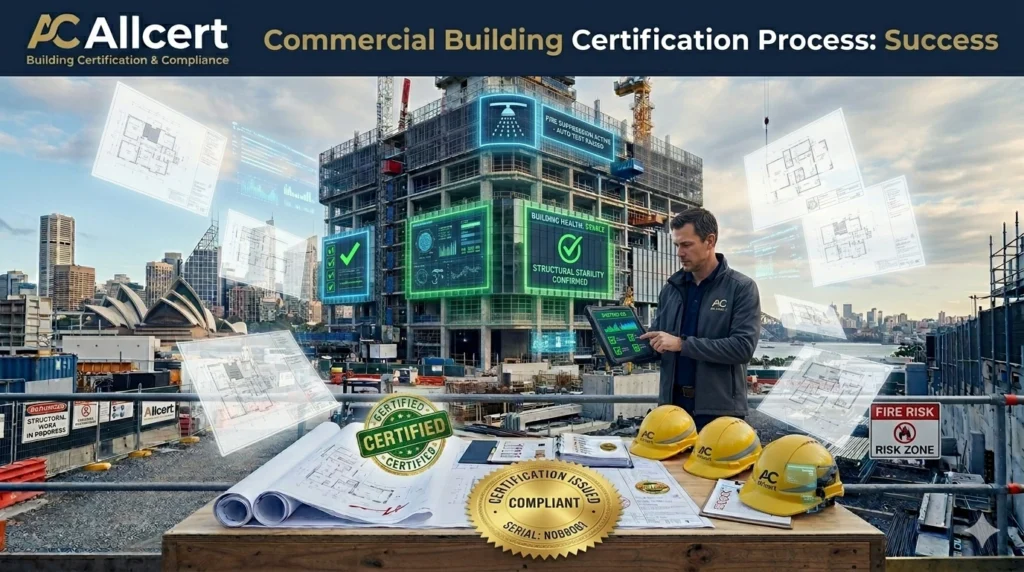
Flexibility is another advantage. A private building certifier can work around the builders construction program. Conduct staged inspections to suit sequencing. They can also provide -application advice reviewing documentation before formal lodgement to identify deficiencies early and prevent costly resubmissions.
It is critical to understand that a private building certifier in NSW must be accredited by the NSW Building Commission and act independently. They are unable to certify their job or project if they have a conflict of interest. This independence is a key component of the certification framework. protects all parties involved.
How to Apply for a Construction Certificate in NSW?
If you are planning a development or significant alterations and additions you will need to apply for a construction certificate NSW after receiving development consent. Here is a general overview of the process:
Step 1 – Obtain Development Consent
Before a construction certificate NSW can be issued your development application must be approved by the council or consent authority. The DA approval will outline the conditions that must be satisfied.
Step 2 – Engage a Certifier Early
Appoint an accredited private certifier of building certification before you finalise your documentation. They will review DA conditions advise on required documentation and confirm critical inspection hold points.
Step 3 – Prepare Compliant Documentation
Compile construction drawings, engineering certificates, specifications BASIX certificates (where applicable) and evidence of compliance with all pre-commencement DA conditions.
Step 4 – Lodge the Application
Submit your application to your Private Certifier NSW. They will assess documentation against the NCC, the development consent and relevant Australian Standards.
Step 5 – Receive the Construction Certificate
Once documentation is satisfactory and conditions are met the construction certificate NSW will be issued. Construction must not commence until this certificate is formally in hand.
Step 6 – Critical Stage Inspections
Your certifier will nominate mandatory inspection hold points throughout the build. Each stage must be. Signed off before work proceeds.
Step 7 – Occupation Certificate
Once construction is complete and all essential services are commissioned the final step is obtaining an Occupation Certificate allowing the building certification to be lawfully occupied.
Tips to Avoid Certification Delays on Commercial Projects
- Engage your private building certifier at the DA stage not after consent is issued
- Conduct a -DA meeting with council to identify likely conditions early
- Use consultants across all disciplines including fire, structure, hydraulics and accessibility
- Maintain a conditions register to track DA conditions and evidence requirements
- Never commence construction before the construction certificate NSW is formally issued
- Schedule inspections in advance to align with your construction program
Conclusion
Commercial building certification in NSW is a structured but often complex process. The common issues. From incomplete documentation and NCC non-compliance to accessibility failures and essential services gaps. Are largely preventable with the right expertise and approach from day one.
Engaging a private building certifier early understanding your obligations under the EP&A Act and following the correct pathway to apply for a construction certificate NSW can make the difference between a smooth project delivery and a costly time-consuming dispute.
If you are planning a development in NSW and need expert guidance, the team, at All Cert Group is ready to help. As a trusted Private Certifier NSW we provide reliable certification services across a wide range of commercial building classes. Contact us today to discuss your project requirements.